


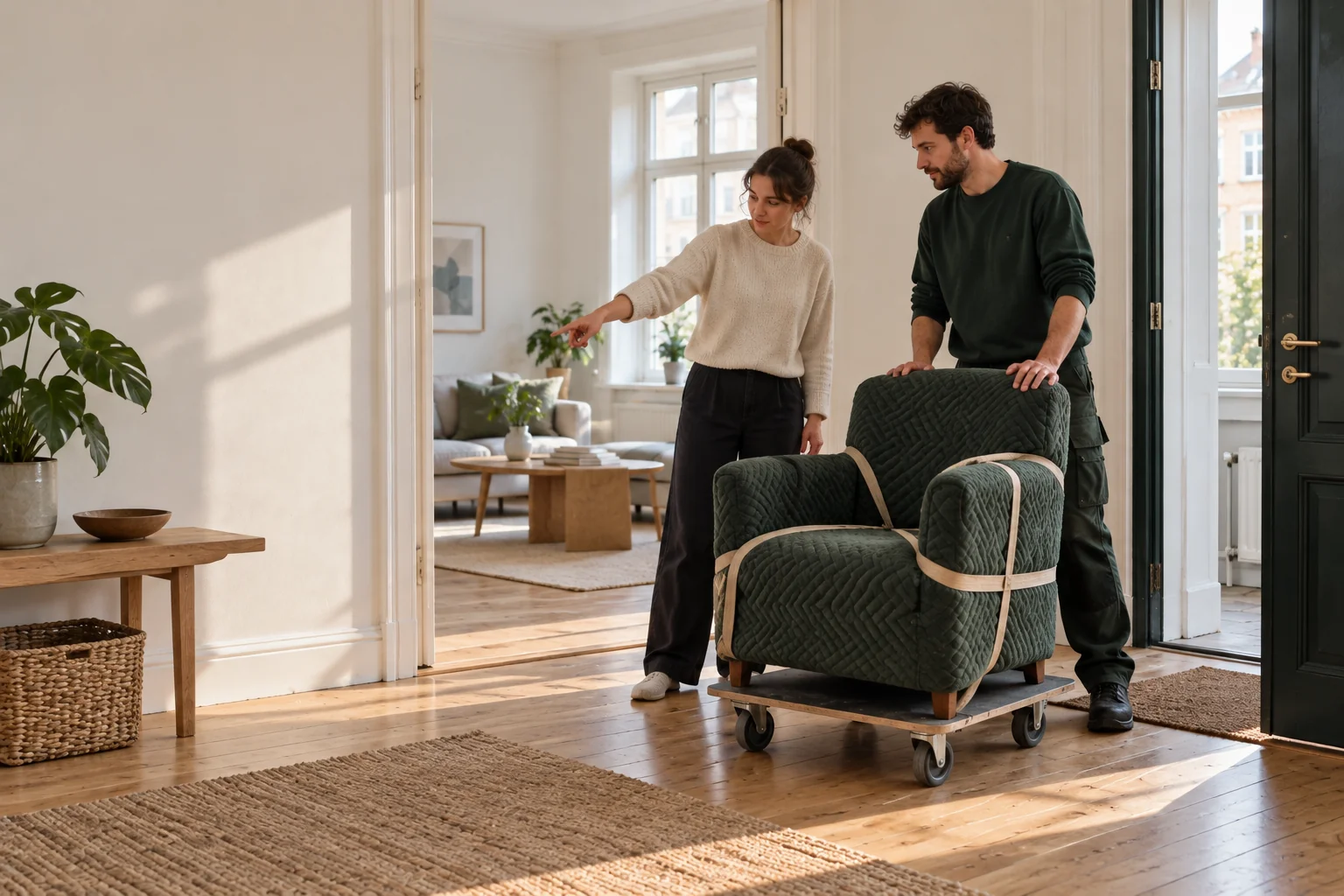
A customer and driver discuss carrying a protected armchair inside at the entrance

Transport

To the kerb?
Or all the way inside?

Choose furniture delivery to the kerb or carrying into your home. Clarify loading, unloading, stairs and who lifts at both addresses before booking.

Calculate your price
About 3 min readRead the guide

With Teleporter, you choose whether you handle the furniture, the driver helps or extra helpers come along. The arrangement needs to work at both addresses. The phrase kerbside delivery alone does not explain who lifts the furniture out of the van, so agree that part explicitly.

The essentials, in brief.

  • Without carrying help, you load and unload.
  • A helping driver may still need another person.
  • If you cannot lift, book a sufficient team.

01 · Three different levels of help

Three different levels of help

With a vehicle and driving only, you organise carrying to the van, loading, unloading and carrying onwards. With a helping driver, the driver joins the handling, but you still need enough people for items that require a team lift.

Choose a driver with additional helpers when the team must do the carrying without you. Tell support about heavy furniture and difficult access in advance. Select the service for the work needed, not just the distance between the two addresses.

02 · Do you need the same help at both ends?

Do you need the same help at both ends?

Describe the actual task. You might have brought a purchase down to the street already but need help taking it upstairs at home. State where the item starts and where it should end, rather than writing only “delivery”.

Also agree who unloads the vehicle. If you and a friend will carry onwards, make sure you can handle the item safely. Do not rely on free extra lifting from a driver booked for driving only.

03 · When is delivery complete?

When is delivery complete?

Under the local minute tariff, time runs while the agreed task is being carried out. If carrying inside is included, arrival at the building does not finish the job. Unloading and the agreed carrying work count towards the paid time.

If you unload and then carry onwards yourself, the driver’s task can finish after the agreed transport and unloading are complete. The 60-minute minimum for a vehicle booking still applies even if the task finishes sooner.

04 · Do stairs cost extra?

Do stairs cost extra?

The ordinary local minute service has no separate floor, stair or long-carry surcharge. Longer carrying can instead increase the time and therefore the bill. Explain the floor, lift and distance from the van before booking.

Measure uncertain passages and disclose heavy items. More helpers do not make a narrow doorway wider. If an item cannot fit or cannot be handled safely, contact support to agree the next step rather than forcing the move.

Ready for moving day?

One final review.

  • Describe the starting and final placement.
  • Agree who loads and unloads.
  • Arrange enough help at both addresses.
  • Explain stairs and narrow passages.
Find a vehicle and carrying help

Have a good move — and a good start at your new address.

Back to the blog
From plan to move

Ready for your
next move?

Calculate your price
Go to article

Get Teleporter

Choose your app store.

Welcome credit

GetDKK 100in credit when you sign up.

Open Messenger

Contact Teleporter

Choose language

Dansk

Transport

To the kerb?
Or all the way inside?

Choose furniture delivery to the kerb or carrying into your home. Clarify loading, unloading, stairs and who lifts at both addresses before booking.

About 3 min readRead the guide
A customer and driver discuss carrying a protected armchair inside at the entrance

With Teleporter, you choose whether you handle the furniture, the driver helps or extra helpers come along. The arrangement needs to work at both addresses. The phrase kerbside delivery alone does not explain who lifts the furniture out of the van, so agree that part explicitly.

The essentials, in brief.

  • Without carrying help, you load and unload.
  • A helping driver may still need another person.
  • If you cannot lift, book a sufficient team.

01 · Three different levels of help

Three different levels of help

With a vehicle and driving only, you organise carrying to the van, loading, unloading and carrying onwards. With a helping driver, the driver joins the handling, but you still need enough people for items that require a team lift.

Choose a driver with additional helpers when the team must do the carrying without you. Tell support about heavy furniture and difficult access in advance. Select the service for the work needed, not just the distance between the two addresses.

02 · Do you need the same help at both ends?

Do you need the same help at both ends?

Describe the actual task. You might have brought a purchase down to the street already but need help taking it upstairs at home. State where the item starts and where it should end, rather than writing only “delivery”.

Also agree who unloads the vehicle. If you and a friend will carry onwards, make sure you can handle the item safely. Do not rely on free extra lifting from a driver booked for driving only.

03 · When is delivery complete?

When is delivery complete?

Under the local minute tariff, time runs while the agreed task is being carried out. If carrying inside is included, arrival at the building does not finish the job. Unloading and the agreed carrying work count towards the paid time.

If you unload and then carry onwards yourself, the driver’s task can finish after the agreed transport and unloading are complete. The 60-minute minimum for a vehicle booking still applies even if the task finishes sooner.

04 · Do stairs cost extra?

Do stairs cost extra?

The ordinary local minute service has no separate floor, stair or long-carry surcharge. Longer carrying can instead increase the time and therefore the bill. Explain the floor, lift and distance from the van before booking.

Measure uncertain passages and disclose heavy items. More helpers do not make a narrow doorway wider. If an item cannot fit or cannot be handled safely, contact support to agree the next step rather than forcing the move.

Ready for moving day?

One final review.

  • Describe the starting and final placement.
  • Agree who loads and unloads.
  • Arrange enough help at both addresses.
  • Explain stairs and narrow passages.
Find a vehicle and carrying help

Have a good move — and a good start at your new address.

Back to the blog
From a good plan
to a good move.